
TalkyTalky
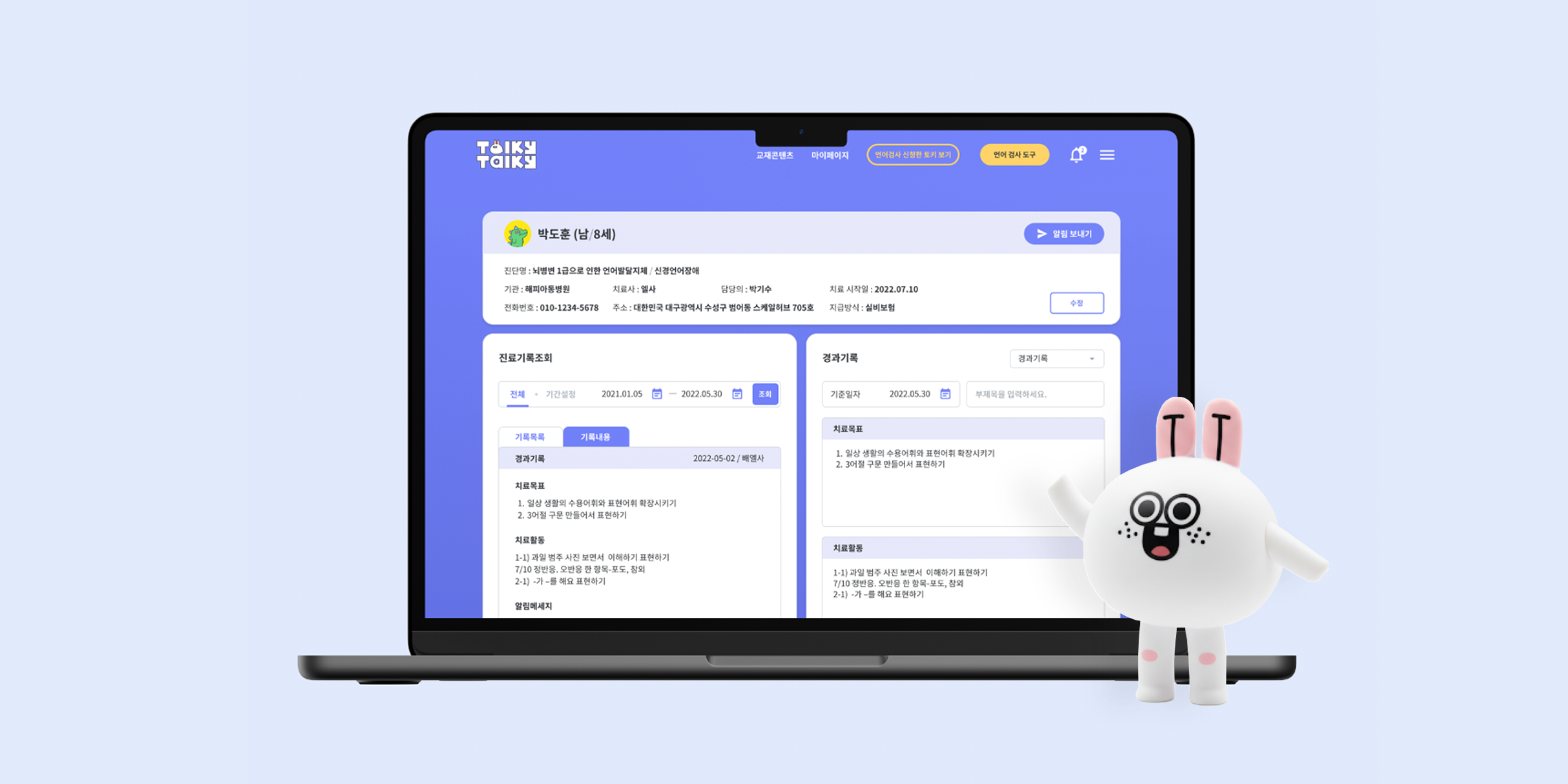
TalkyTalky is an AI-powered speech-language rehabilitation platform that supports the assessment and rehabilitation of communication disorders across the lifespan, from developmental language disorders to cognitive conditions. It is Korea’s first remote platform to integrate voice-based AI for identifying language disorders, a large multimodal model (LMM) that generates rehabilitation goals and materials, and a Retrieval-Augmented Generation (RAG)–based personalized counseling system.

Improved Accessibility to Language Rehabilitation

Standardization of Rehabilitation Quality

Reduction of Medical Costs
As Korea’s first AI-powered remote speech-language rehabilitation platform for all ages, TalkyTalky implements an end-to-end remote rehabilitation ecosystem.
AI Voice-Based Language Disorder Identification
By performing five structured speech tasks, TalkyTalky analyzes articulation, prosody, voice quality, and linguistic characteristics. This enables automatic screening of language disorders in both online and offline integrated environments.
Speech & Language Rehabilitation- Specialized Multimodal Generative Model (sLMM)
Trained on clinical data from speech-language pathologists, the sLMM automatically generates patient-specific short- and long-term rehabilitation goals, therapy materials, and feedback statements. Its text-and-image generation capability also creates visual training materials. Developed as a lightweight model at roughly one-tenth the size of large public LMMs, it supports security and operational efficiency.
RAG-Based Personalized Automated Counseling System
Patient voice-assessment results and counseling records have been organized and used to train Q&A-pair datasets. The system generates RAG-based responses to questions from caregivers and therapists and provides personalized counseling feedback aligned with each patient’s progress and treatment history.
End-to-End Remote Language Rehabilitation Ecosystem
TalkyTalky has been designed and implemented as a three-stage structure: (1) speech to language-disorder identification through AIVIS-based voice analysis; (2) assessment results to personalized rehabilitation-goal generation through sLMM; and (3) rehabilitation goals and progress records to counseling-response generation through RAG. This integrated structure delivers a complete remote workflow from speech analysis and goal setting to feedback and counseling.